Tuesday, July 19, 2011

Awesome New Trick for Titles

I got this idea from my brother, and I think its awesome. He was using it to design album covers, but it totally works for book titles too.

First trick is to go to to the main page of Wikipedia and click "Random Article" in the top of the left sidebar. Then keep clicking random and see what comes up. Here are 5 title examples I've got from Wikipedia:

-Marqu
-Pas de Deux
-Sotos Point
-Crow-stepped (from crow-stepped gable)
-Castalius

The other cool trick is to use the random quotes page from QuotationsPage.com. What my brother does is use the last few words of the last quote on the page. Here are some examples:

-Whistle for Him
-A Bushel of Brains
-Room Temperature
-Devourer of All Things
-Hanged to a Lampost

Just keep refreshing and you get lots of cool things.

One last thing. To expand and further develop your title ideas, check out the 'Last 7 Days' page on Flickr, and then imagine the top right corner photo as your book cover. That way it gives you even more to work with, and helps you get more ideas. For example, lets take the title 'Devourer of All Things'. Pretty interesting title that calls to mind a lot of ideas. But let's put it with the top right corner picture from Flickr, which for me right now, is this:
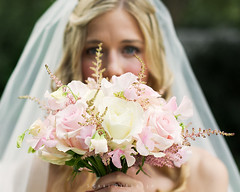
The picture adds to the already interesting title. This picture gives us a character (nervous looking bride) and a situation (a wedding). So who's the "devourer"? The bride? The groom? A jealous rival?

Just a great way to get ideas flowing, and I thought I'd share. What do you think?

Sarah Allen

Labels:

Wednesday, July 6, 2011

A Poem a Day Keeps the Cliche Away


I don't know about you, but after a while of working on a piece, I start worrying that I'm becoming less and less original, and that I'm reverting to rote phrases and falling back on things I've heard people say before. I try to avoid it as much as possible, but sometimes it can be hard. Sometimes it takes more than prose to get true honesty and true beauty into your language, and that's where poetry comes in.

All good writing is poetic, in my opinion. I've decided to try and get in the habit of reading a bit of poetry every night, just a poem or two, maybe even trying to memorize the really good ones, and my hope is that doing this will get my language of out the rut of cliche, and imbue it with the spark and life that I sort of feel it missing.

Do any of you do this, and has it worked? Any recommendations for me?

The two collections I really like are the Poetry 180 books edited by Billy Collins, and the Good Poems series edited by Garrison Keilor. I know some people don't have the highest opinion of these ones, but I absolutely love them, and think they're easy to get into and fantastic poetry collections to start out with.

And with that, I'll leave you with two of my favorite poems of all time. One older, one newer, and both coincidentally about God. Not particularly trying to be religious with this post, but I LOVE how differently each poet approaches the same topic, and how successful they both are in completely different ways.
***
Pied Beauty, by Gerard Manley Hopkins

Glory be to God for dappled things –
For skies of couple-colour as a brinded cow;
For rose-moles all in stipple upon trout that swim;
Fresh-firecoal chestnut-falls; finches’ wings;
Landscape plotted and pieced – fold, fallow, and plough;
And áll trádes, their gear and tackle and trim.

All things counter, original, spare, strange;
Whatever is fickle, freckled (who knows how?)
With swift, slow; sweet, sour; adazzle, dim;
He fathers-forth whose beauty is past change:
Praise him.


***
God Got a Dog, by Cynthia Rylant

He never meant to.
He liked dogs, He'd
liked them ever since He was a kid,
but He didn't think
He had time for a dog now.
He was always working
and dogs needed so
much attention.
God didn't know if He
could take being needed
by one more thing.
But He saw this dog
out by the tracks
and it was hungry
and cold
and lonely
and God realized
He'd made that dog
somehow,
somehow He was responsible
though He knew logically
that He had only set the
world on its course.
He couldn't be blamed
for everything
But He saw this dog
and He felt bad
so He took it on home
and named it Ernie
and now God
has somebody
keeping His feet warm at night.

***

Ah, aren't those so great? (I hope I don't get in trouble for that second one, copyright issues and what-not, but I my intentions towards Ms. Rylant's work are completely honorable, and besides, I couldn't help myself. I think you should all go buy her God Went To Beauty School collection right now). Anyway, are you guys big poetry readers? Do you agree that reading it can be a huge help in our own work?

Sarah Allen

Labels:

Tuesday, June 28, 2011

To Jumpstart Your Writing


When you sit down to write, whether that's first thing in the morning or late at night, how do you jumpstart yourself in to writing mode?

That is my question for today. This has been a big problem for me lately, and I'm sure its something other people struggle with too. When I only have small chunks of time here and there to write, as opposed to big blocks set aside specifically for writing, I have a hard time getting in to the groove before I've run out of time. Does this happen to you? And how do you make it so that doesn't happen, and you can just hit the ground running...er, computer screen typing?

I've tried a few things that do help a little. Like ending in the middle of a scene, or remembering the last sentence I wrote and forming the next sentence in my mind while I'm away from the computer. But I still feel like it takes me a good twenty or thirty minutes to really get in zone where things start really coming, and sometimes twenty or thirty minutes is all you have. Sometimes less.

Am I alone in this or does it happen to you as well? Is there a way to get rid of or at least shorten the less productive warm-up time? Or is it just a natural part of the writing process that just happens and has to be dealt with?

Sarah Allen

Labels:

Wednesday, June 22, 2011

Why Writing for Teenagers and Adults is the Same


One piece of writing advice I hear quite often is to keep ones readers or target audience in mind. It makes sense, right? I mean, Judy Blume, Steven King and Fyodr Dostoevsky probably all have very different readerships.

Lies. At least partly. I've read and loved all three of those authors, and know lots of other people who have too. I mean, you can make generalities, but since when have generalities been good for writing?

My point is this. The only real audience you can write "to" is you. And by you I mean everybody. Let me explain. (No, there is too much. Let me sum up.) When you are honest and very specific, and write things that you enjoy and that mean something important to you, then your readers are able to grasp that important meaning through those specific details. By being specific you become universal. People can relate to grass stains and cigarette smoke and the first day of school. Those things may mean something different to different people, but they have much more meaning than if you just said happy or anxious or sad.

That is why writing for adults and teenagers is the same. The point isn't to pander or adjust to any preconceived "level." The point is to tell the most interesting story you know in the most meaningful way you know how, whether the main character is 7, 17, or 70. You can't control what any given reader is going to take away from your work, because they will all take away something different anyway. Our job is to do our best to make sure they can take away something. No matter what age they are.

When you really get down to it, we're all just human.

Sarah Allen

Labels:

Tuesday, June 21, 2011

How do you plot?


Plot has always been something I've struggled with. I love characters and intriguing relationships and situations and scenarios, and can come up with those in a snap, but getting those ideas from the character scenario point to a novel worthy plot is a whole different thing, and much harder for me.

But I've been learning. The system I use currently is this: I start out with the character and scenario that I like and that I think I want to work with. Then I look through old notebooks and books from my bookshelf and cards from the game Liebrary and think and think until I have a bullet-point type list of plot points, just like a half sentence describing each. Something like, "Ben finds the lost golden retriever on his porch". I grow the list as much as I can until its nice and long. Then I break the list up into tentative chapters, make sure I have enough, see where the plot holes are and try and fill in where I need to. Then I go chapter by chapter, changing plot points around or adding as needed.

What do you do? Do you just start from the character scenario place and just go and see where it takes you? If so, how? Or do you have paragraph length descriptions for each chapter? I would seriously love to know how you go about building a story. Specifics are good, I think we all could use some advice and fresh ideas.

Happy writing!
Sarah Allen

Labels: